


MBBS Admission Through NRI Quota in India: Fees Structure &
- April 25, 2026
- 7 Min Read




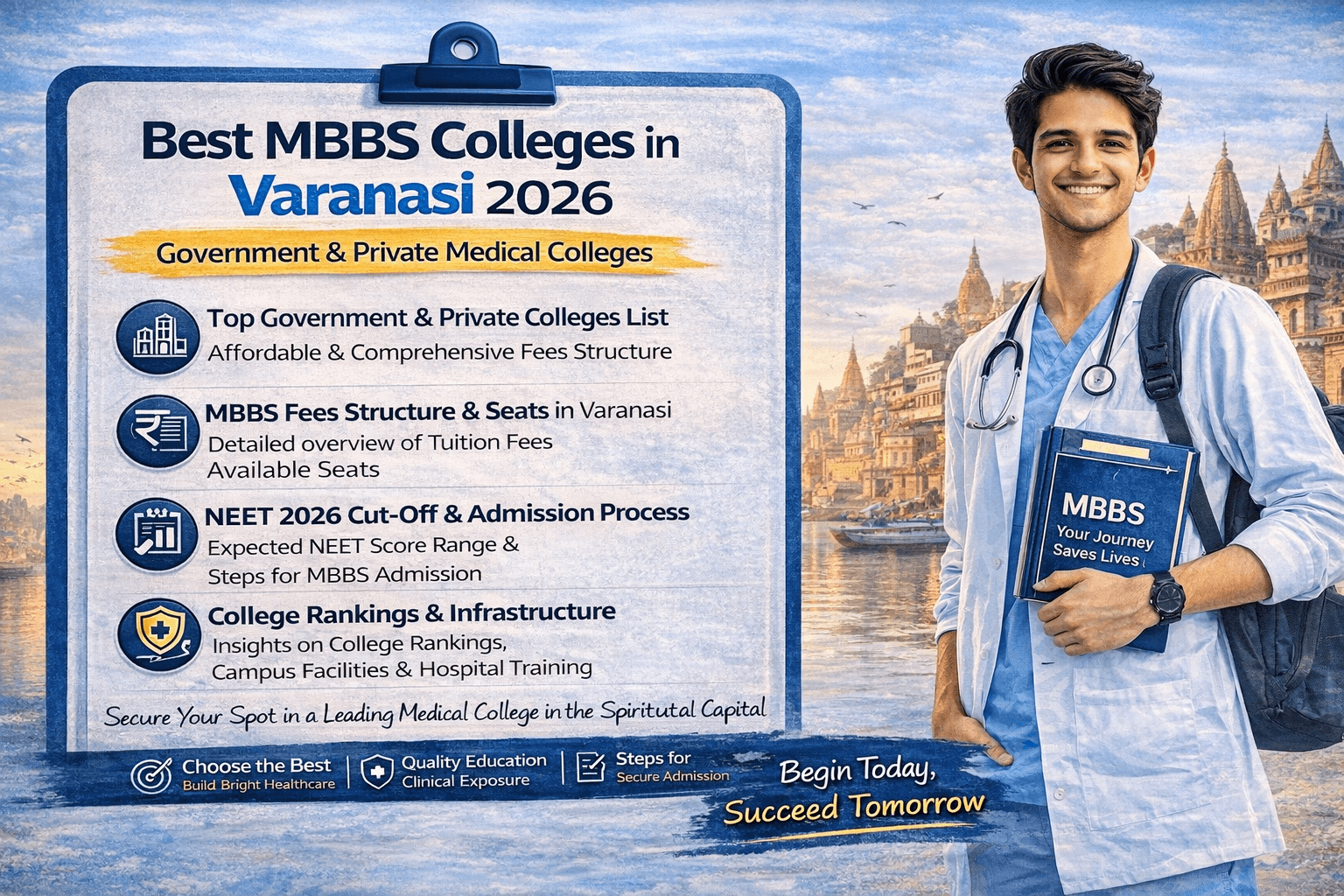
Just before sunrise in Varanasi, the city begins to wake slowly. Temple bells echo softly, tea vendors pour the first cups of chai, and the river breeze moves through narrow lanes.
Among the early walkers are students carrying backpacks and tired eyes, heading toward hostels, libraries, and hospital wards.
Most of them share the same dream — to become a doctor.
For many students across India, that dream begins with NEET preparation. Months of study, pressure, and hope eventually lead to one question: Where will my medical journey start?
For thousands of aspirants every year, that journey begins in Varanasi, a city known not only for its ancient heritage but also for its respected medical institutions.
Among the most respected government medical colleges in India, IMS BHU stands as a prestigious destination for NEET aspirants.
Located within the large campus of Banaras Hindu University, the institute offers a unique academic environment. Wide roads, historic academic buildings, and students cycling to lectures create an atmosphere that feels both traditional and inspiring.
The attached Sir Sunderlal Hospital serves as the primary teaching hospital, receiving patients from across eastern Uttar Pradesh and neighboring states.
For medical students, this hospital becomes the most important classroom.
Established: 1960 (as part of BHU medical education system)
MBBS Seats: Approx. 100+
Annual Fees: ₹7,000 – ₹10,000 (government institution)
Teaching Hospital: Sir Sunderlal Hospital
Admission: Through NEET + All India Counselling
General Category: Around 660+ marks
Cut-offs vary depending on competition and counselling rounds.
Students at IMS BHU often say that the experience here teaches more than medicine — it teaches empathy, responsibility, and patience.
Another important institution connected to BHU is the Mahamana Pandit Madan Mohan Malaviya Cancer Centre.
This centre works closely with Tata Memorial Centre, one of India’s most respected cancer treatment institutions.
The focus here is on oncology research and treatment, making it an important place for medical training and specialization exposure.
Advanced cancer research
Collaboration with Tata Memorial Centre
Exposure to specialized medical fields
Opportunities for clinical training and research
Working in oncology environments often shapes doctors emotionally and professionally, as cancer care demands both knowledge and compassion.
Recent trends show that government MBBS colleges in North India usually close around 610–620+ marks for General category seats through counselling.
However, top institutions like IMS BHU typically require much higher scores.
For students considering private medical colleges, Heritage Institute of Medical Sciences is one of the known options in Varanasi.
The campus is located slightly away from the busiest areas of the city, offering a more organized and modern environment.
Modern infrastructure and laboratories
Structured teaching environment
Growing hospital patient exposure
Practical clinical learning
Type: Private Medical College
MBBS Seats: Around 150
Annual Fees: ₹11–14 lakh (approx)
Admission: Through UP NEET Counselling
Private medical colleges generally admit students with lower NEET scores compared to government colleges.
Estimated range:
General Category: Around 430–500 marks
Cut-offs vary each year depending on counselling rounds and seat availability.
Very low tuition fees
High competition in NEET
Heavy patient flow for clinical training
Strong academic reputation
Higher tuition fees
Modern infrastructure
Moderate NEET cut-off
Structured campus environment
Choosing between them depends on NEET score, financial planning, and career priorities.
All MBBS admissions in Varanasi follow the national NEET-based system.
NEET is mandatory for MBBS admission in India.
Two counselling routes exist:
All India Quota Counselling (MCC)
State Counselling (UP NEET Counselling)
Students must select colleges carefully during counselling rounds.
After allotment, candidates must report to the college with required documents.
Studying medicine anywhere is demanding — thick textbooks, long hours in hospitals, and frequent exams.
But students in Varanasi often say the city itself helps them stay grounded.
After long days in lectures and wards, many students walk to the Ganga ghats. Sitting quietly by the river gives them a moment to breathe.
In those quiet moments, the stress of exams fades slightly — and the purpose of becoming a doctor feels clearer.
Perhaps that is the unique spirit of Varanasi. It reminds people that life is fragile and worth caring for.
Every doctor once stood where you stand now — holding an admission letter and wondering what the next five years would bring.
In Varanasi, that journey unfolds through lecture halls, hospital wards, and long nights of study.
Students arrive uncertain. Slowly they learn how to diagnose, how to listen, and how to carry the responsibility that comes with a white coat.
By the time they leave, they are no longer just students.
They are doctors ready to serve.
And somewhere in the quiet streets of Varanasi, another generation begins that same journey again.
Institute of Medical Sciences (IMS), Banaras Hindu University is the most reputed government medical college in the city.
Expected cut-off for General category is around 660+ marks, though it varies each year.
Heritage Institute of Medical Sciences is one of the major private MBBS colleges in Varanasi.
Government MBBS fees at IMS BHU are around ₹7,000–₹10,000 per year.
Private MBBS colleges typically charge ₹11–14 lakh per year.
Yes, due to strong academic institutions, busy hospitals, and a supportive student environment.