



The night before the result, sleep feels like a luxury no NEET aspirant can afford.
You lie in bed, staring at the ceiling, replaying every question you marked “maybe,” every guess that could change your future. Was that Biology answer correct? Did you mess up that Physics calculation? The mind doesn’t rest; it negotiates, doubts, and hopes.
And somewhere between anxiety and excitement, one thought keeps coming back:
“What rank will I get?”
That question is not just about a number. It’s about college, dreams, expectations, and the quiet promise you made to yourself months ago.
The Moment After the Exam
The exam ends. You walk out of the center, surrounded by conversations.
Some students sound confident.
Some are already calculating scores.
Some stay silent, holding everything inside.
You might open the answer keys later that day. Slowly, carefully, you start matching answers. Each correct response brings a tiny wave of relief. Each mistake feels heavier than it should.
And then comes the total.
Let’s say you score 620… 650… 680…
Now the real uncertainty begins.
Marks alone don’t tell the full story. Rank depends on thousands of other students—their scores, their performance, their consistency. That’s where the confusion grows.
Why Marks Aren’t Enough
Every year, NEET gets more competitive.
A difference of just 5–10 marks can shift your rank by hundreds or even thousands of positions. That’s what makes prediction so difficult and so important.
You may ask:
Without a clear idea of your rank, all decisions feel uncertain.
Enter the NEET Rank Predictor
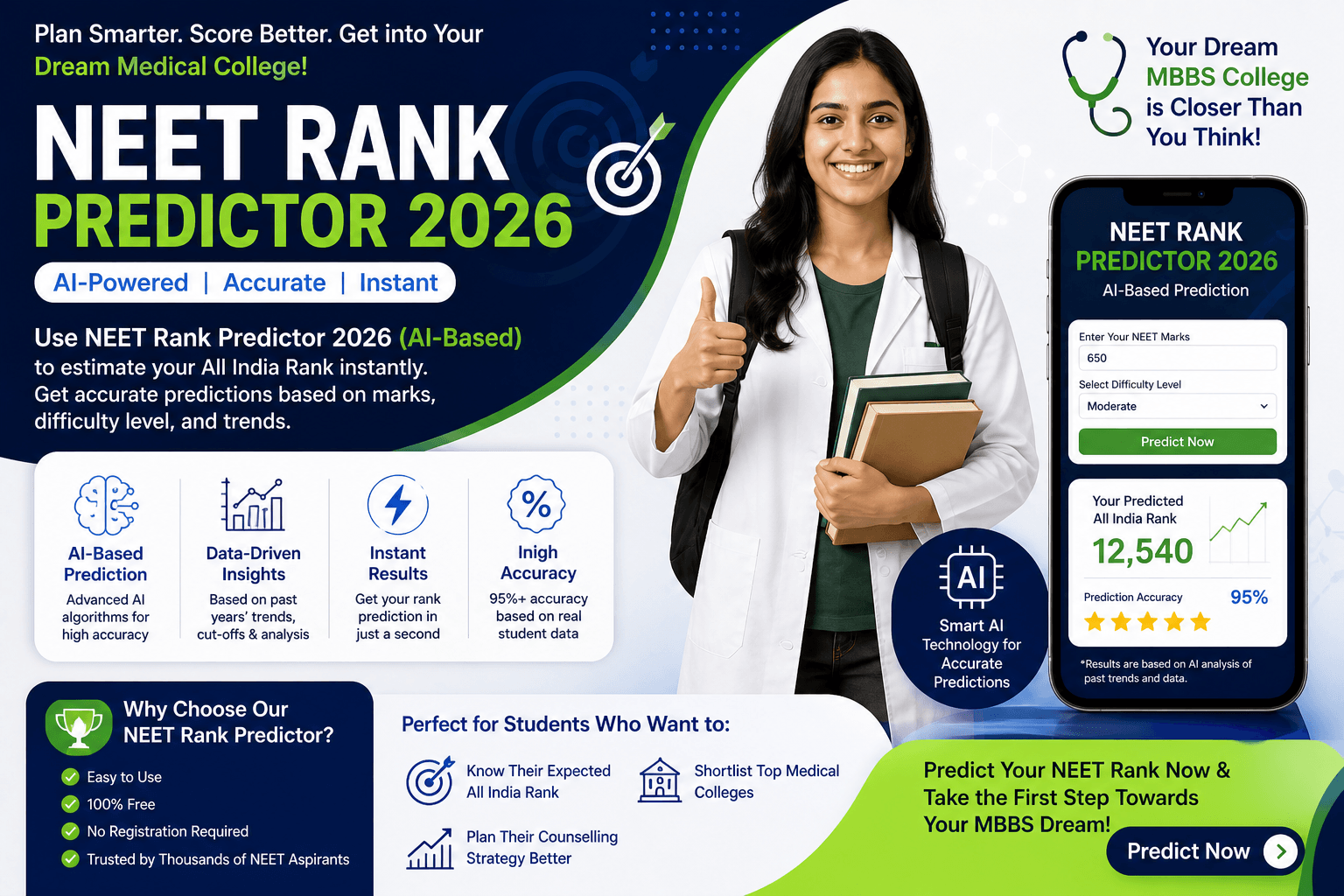
This is where a NEET Rank Predictor 2026 (AI-Based) becomes more than just a tool; it becomes a guide in a moment of chaos.
Think of it as that one calm friend who doesn’t panic, who looks at your marks and says:
“Okay, here’s where you realistically stand.”
Instead of guessing blindly, you get an estimate based on:
It connects the dots that most students struggle to see.
How accurate is it, actually?
Most good predictors fall in this range:
Example:
If the predictor shows AIR 5,000, your real rank could be:
Why AI predictors are “good but not perfect.”
AI-based tools sound powerful, but they still depend on past data + assumptions, not future reality.
They usually calculate rank using:
So basically, they answer:
“If this year behaves like previous years, your rank will be around this.”
But the problem is…
Every NEET year behaves a little differently.
What causes prediction errors?
This is where reality hits.
Even the best predictor can go wrong because of:
1. Paper difficulty changes
Example: A score of 650 might be:
2. Number of students
3. Answer key changes
This can shift rank by hundreds or even thousands
4. Your own calculation mistakes
When is it MOST accurate?
Rank predictors work best in these situations:
High scorers (650+)
After the final answer key
How It Actually Helps You
The biggest advantage isn’t just the predicted rank, it’s the clarity that comes with it.
Imagine this:
You enter your score.
Within seconds, you see a predicted All India Rank range.
Suddenly:
You can begin to answer real questions:
It turns uncertainty into direction.
A Small Story You Might Relate To
Last year, a student named Aarav (name changed) scored around 635.
He was stuck in doubt.
His friends told him different things:
Confused, he used a rank predictor.
The result wasn’t overly optimistic. It showed a realistic range, good, but not extraordinary.
At first, it stung.
But then something shifted.
Instead of dreaming blindly, Aarav got strategic:
When the results finally came, his actual rank was very close to the prediction.
And because he had prepared in advance, he didn’t panic; he acted.
Why AI-Based Prediction Matters
Older methods relied on rough estimates. They often missed the nuances.
But AI-based predictors work differently.
They analyze patterns from:
It’s not magic—but it’s far more refined than guessing.
Still, one thing must be clear:
It’s a prediction, not a guarantee.
Think of it as a compass, not a fixed destination.
The Emotional Side of It
Let’s be honest, tools don’t remove emotions.
Even after seeing your predicted rank, you may feel:
And that’s completely normal.
Because NEET is not just an exam.
It’s months (sometimes years) of effort, early mornings, late nights, sacrifices, and silent resilience.
A number cannot define all of that.
Using the Predictor the Right Way
If you’re planning to use a NEET Rank Predictor 2026, keep a few things in mind:
The goal is not to obsess over rank, but to prepare for what comes next.
What Comes After Prediction
Once you have an idea of your rank, shift your focus.
Start preparing for:
This is where many students lose time, waiting instead of acting.
Don’t wait.
Even a rough direction is enough to begin.
Final Thoughts
That night before the result may still feel long.
The uncertainty won’t disappear completely.
But having a sense of where you stand can make it easier to breathe.
A NEET Rank Predictor doesn’t give you your future; it gives you a starting point.
And sometimes, that’s all you need.
Because in the end, your journey isn’t decided by a single number.
It’s shaped by what you do after you see it.


