



There’s a strange silence that fills a house after the NEET exam is over.
For months, everything revolves around chapters, mock tests, revision schedules, chemistry formulas stuck on bedroom walls, and sleepless nights before exams. Parents whisper about cutoffs over dinner. Students stop counting festivals and start counting marks instead. Then one day, the exam ends… and suddenly another fear begins.
“Will I get a government medical college?”
“Should I try private colleges too?”
“Is my score enough for MBBS?”
That phase after NEET feels heavier than preparation itself. Because now the dream is close enough to touch, but uncertain enough to keep you awake.
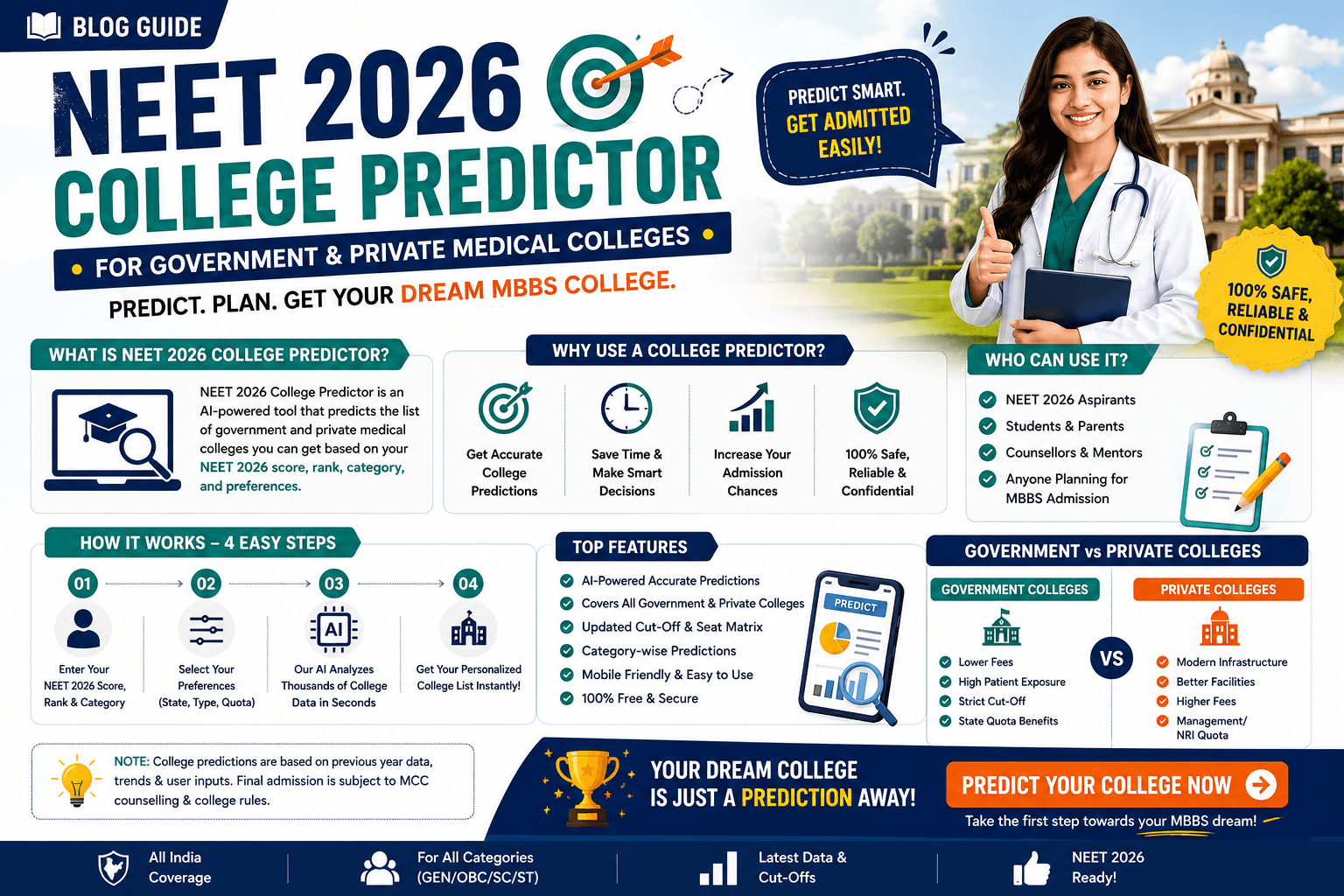
This is exactly why, in 2026, the NEET College Predictor has become so important for students across India. It is no longer just a tool. For many aspirants, it feels like the first ray of clarity after months of confusion.
The Emotional Rollercoaster After NEET
Every student reacts differently after the exam.
Some come home confident, already calculating AIR predictions in their heads. Some avoid discussing answers completely because they know one wrong answer can change everything. Others spend entire nights watching YouTube analysis videos, trying to understand whether their marks are “safe.”
And somewhere in between all this anxiety comes the biggest question:
“What colleges can I actually get?”
That question matters because medical admissions in India are complicated. Government colleges, private colleges, AIQ counselling, state quotas, category reservations, fee differences, everything feels overwhelming at once.
A NEET college predictor simplifies this chaos.
Instead of scrolling endlessly through random cutoff PDFs from previous years, students can get a realistic idea of where they stand.
What Exactly Does a NEET 2026 College Predictor Do?
A NEET College Predictor compares your expected marks, rank, category, domicile state, and counselling quota with previous admission trends.
Based on that data, it estimates your chances in:
The biggest advantage is not just prediction. It’s emotional preparation.
A student scoring 610 may realize they still have strong government college possibilities in their state quota. Another student scoring 470 may understand early that private colleges or deemed universities could be better options instead of wasting counselling rounds emotionally.
Sometimes clarity itself becomes relief.
Government Medical Colleges: Why Everyone Dreams About Them
For most NEET aspirants, the dream begins with a government MBBS seat.
Not only because of reputation, but also because the fees are affordable for middle-class families. In many colleges, annual fees are lower than what coaching institutes charge for one year.
That’s why competition becomes brutally intense.
Even a difference of 5–10 marks can shift ranks by thousands. One unexpected cutoff jump can completely change counselling outcomes.
A good college predictor helps students understand realistic possibilities instead of false hope.
For example:
Of course, every year changes slightly. That’s why updated 2026 prediction data matters.
Private Medical Colleges Are Not “Plan B” Anymore
There was a time when students felt ashamed of discussing private medical colleges.
That mindset is slowly changing.
Today, many private colleges have excellent infrastructure, modern labs, strong hospitals, and experienced faculty. Several doctors graduating from private colleges are performing exceptionally well in PG entrances and clinical practice.
The real concern for most families is affordability.
Private MBBS fees can range from manageable to extremely expensive, depending on the college and state. This is where a college predictor becomes useful again. It helps families prepare financially before counselling panic starts.
Because truthfully, NEET counselling affects entire families emotionally and financially, not just students.
|
Factor |
Government Medical College |
Private Medical College |
|
Fees |
Very affordable for most families |
Usually, it is much higher and can be financially stressful |
|
NEET Cutoff |
Extremely high due to intense competition |
Comparatively lower in many colleges |
|
Admission Difficulty |
Harder to secure because seats are limited |
Easier if the score is moderate and the budget allows |
|
Patient Flow |
Very high patient exposure in hospitals |
Patient flow varies from college to college |
|
Infrastructure |
Some colleges are old but clinically strong |
Often, modern buildings and updated facilities |
|
Hostel & Campus Life |
Usually simple and traditional |
Often more comfortable and modern |
|
Faculty Quality |
Strong academic reputation in many colleges |
Depends on the institution |
|
Clinical Exposure |
Excellent hands-on learning because of the large patient load |
Good in reputed colleges, average in others |
|
Return on Investment |
Very high because fees are low |
It can take years to recover education costs |
|
Scholarships |
More government support and reservations are available |
Limited scholarship options in many colleges |
|
Competition Environment |
Highly competitive and academically intense |
Competitive, but the atmosphere may feel less pressured |
|
Bond Service |
Many states require a mandatory rural/service bond |
Bond policies vary by college and state |
|
Research Opportunities |
Good in top government institutions |
Available mainly in reputed private universities |
|
Social Reputation |
Often carries strong prestige among families and society |
Reputation depends heavily on the specific college |
|
Ideal For |
Students with strong NEET scores and budget concerns |
Students seeking MBBS opportunities with flexible cutoff options |
Why Students Make Mistakes During Counselling
One of the saddest things happens every year after the results.
Students with decent scores fail to secure seats simply because they make poor counselling decisions.
Some fill unrealistic colleges only.
Some ignore state counselling entirely.
Some underestimate private colleges until it is too late.
Some panic after Round 1 and make emotional choices.
This is why prediction tools matter beyond curiosity. They help students build a strategy.
A smart student doesn’t only ask:
“Can I get an MBBS?”
A smart student asks:
“Where do I realistically have the best chance?”
That single mindset shift changes outcomes.
The Human Side Nobody Talks About
Behind every NEET rank is a story.
A father checks the cutoff lists secretly at midnight because he doesn’t want his child to see his stress.
A mother pretending to stay calm while calculating hostel fees on her phone calculator.
A student smiling outside but replaying difficult physics questions again and again in their head.
People often think NEET is only an exam. It isn’t.
It becomes a test of patience, self-belief, family support, and emotional endurance.
That’s why tools like a NEET 2026 College Predictor are valuable. They reduce uncertainty during one of the most emotionally fragile phases of a student’s life.
Even if the prediction is not perfect, direction matters.
How to Use a College Predictor Smartly
A predictor should guide decisions, not control emotions.
Use it wisely:
Most importantly, remember this:
One college does not define the doctor you become.
Many brilliant doctors came from ordinary colleges. What shaped them later was discipline, clinical exposure, consistency, and empathy toward patients.
Final Thoughts
The months after NEET are emotionally exhausting. Every conversation feels connected to ranks, seats, and counselling rounds. Students start comparing themselves constantly. Families carry silent pressure.
But this phase passes.
A NEET 2026 College Predictor can make that journey less confusing by giving students a clearer understanding of their possibilities in government and private medical colleges.
And sometimes clarity is all a tired mind needs.
Because after years of preparation, students deserve something more than fear and uncertainty.
They deserve direction.


